Did your Irish ancestors mark this turning of the year?
How did your ancestors face the autumn Irish equinox? In this letter, we talk about harvest traditions, the light at Sliabh na Caillí, and life on the farm before winter.


Now Reading:
Did your Irish ancestors mark this turning of the year?
Céad Míle Fáilte, and you are very welcome to this week’s Letter from Ireland. The mornings have changed here in Cork. It’s dark now when I come down to the kitchen, and there is a cool edge to the air that was not there a fortnight ago. The blackberries are heavy in the ditches, and the first of the leaves are beginning to turn. How are things in your part of the world today?
I’m settling down with a cup of Barry’s tea, and hope you’ll join me now with a cup of whatever you fancy yourself.
As we notice the turning of the seasons around us, I’m reminded that this was an experience that was very familiar to our ancestors about this time of year. You see, this coming Wednesday, the 23rd, is the autumn equinox, a point at which day and night stand roughly equal before we tip towards the darker half of the year. Nowadays, we tend not to notice, but for farming families, this turn in the season mattered enormously. They mightn’t have marked the equinox itself as a feast day, but they could not ignore the shortening light, the changing weather and most of all the urgent work of bringing in the harvest.
The word that means two things
The Irish word fómhar (pronounced “foh-er”) can mean both autumn and harvest. September is Meán Fómhair in Irish, meaning “the middle of the harvest”, so the whole season took its name from the work of getting the crops safely in before the weather changed. The oats and barley had to be cut and saved, the potatoes lifted, the turf safely home and stacked, and decisions made about which animals could be kept through the winter.
As the evenings shortened, there were simply fewer hours in which to get everything done. They did not need a calendar to tell them that the year was turning; they could read it in the sky, the fields and in the changing length of the day. In fact, some of the people who lived on this island a very long time ago went to great lengths to capture that changing light in stone.
The hill of the old woman
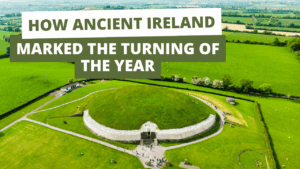
A couple of years back, Carina and I visited a hill in County Meath called Sliabh na Caillí (pronounced “Shleeve na Kal-ee”). Its name means the hill of the “Cailleach”, the old woman or hag who appears throughout Irish tradition. Across the hilltop stands a collection of stone cairns and passage tombs that were established more than five thousand years ago, making them older than nearby Newgrange and the pyramids of Egypt. The largest is known as Cairn T and is aligned so that, on mornings around the equinoxes, the rising sun comes through its passage and illuminates the decorated stone at the rear of the chamber.
For a short while, the sunlight moves across concentric circles, radial designs and other carvings. Then suddenly it’s over, leaving the chamber again in darkness. We don’t know what the builders intended, or the meaning they attached to the light entering the chamber, but the alignment suggests they were observing the movement of the sun with great care and incorporating what they saw into the monument they built.
People still climb Sliabh na Caillí in the early morning darkness around the equinox and stand in the cold waiting for the sun, the same rising sun that people on this hill built into stone more than five thousand years ago.
What our ancestors did at this time of year
Civil, church and land records don’t tell us how people felt when the evenings began to draw in. But folklore collected around Ireland, particularly by the Irish Folklore Commission during the twentieth century, does preserve some rich details about what happened when the harvest was brought home.
Neighbours often worked together in a meitheal, moving from one farm to the next to cut and gather the corn, save the hay and lift the potatoes. No money typically changed hands – a family repaid the help it received by turning up when the work moved on to the next farm. Food was provided during the day and, when the harvest was safely gathered, there might be a supper, music or a dance in the farmhouse. There are also recorded accounts of harvest knots being woven from freshly cut straw, young people then wore them to fairs and gatherings to be exchanged as tokens of affection.
The final sheaf of corn had a particular importance in some districts. It was sometimes called an chailleach, back to the earlier old woman, and the person who cut it could be teased for having “caught the Cailleach”. In some places, the sheaf was shaped into a rough figure or tossed into the field of a neighbour who had not yet finished harvesting.
However, let’s not gloss over the worries and concerns that many families had at this time of year. For the tenant-farming families in our own family trees, bringing in a good harvest did not necessarily mean the end of the worries. Rent was commonly collected twice a year, with one of the main payment days falling in November. Some of the crop or livestock might have to be sold to satisfy the landlord or his agent.
They had to wait for the weeks after harvest to do a final calculation. Would the crop yield enough to pay the rent, keep seed for the following spring and still feed the family through the winter? A poor crop or a fall in prices could leave a family in arrears and facing the possibility of eviction.
So when the final load of the harvest was safely brought in, the feeling must often have been a mixture of relief and uncertainty. There might be a harvest supper, music or a dance when circumstances allowed. But behind the celebration lay the thought: after everyone had been paid, would there be enough left to carry the household through until spring?
So, back to you
This week I have the following question for you: Do you have any harvest traditions in your family? Maybe memories that were passed down from your Irish ancestors? Do let me know in the comments section below.
These are often the fragments worth writing down before they are lost for good. And they are very often the things that lead us back to a particular place, family and way of life.
Thank you, as always, for reading and for sharing this letter.
Slán for now,
Mike.



Only Plus Members can comment - Join Now
If you already have an account - Sign In Here.